The Smart Lens Company




Big Ideas,
Real Impact.
The lens that unlocks the category
Smartglasses will only scale if they look and feel like real glasses. We remove the structural barriers that keep them thick, heavy, and hard to manufacture.
Built on what’s proven
We build on trusted ophthalmic materials and coating systems. Innovation happens in how we integrate, not in taking unnecessary material risks.
Thin without compromise
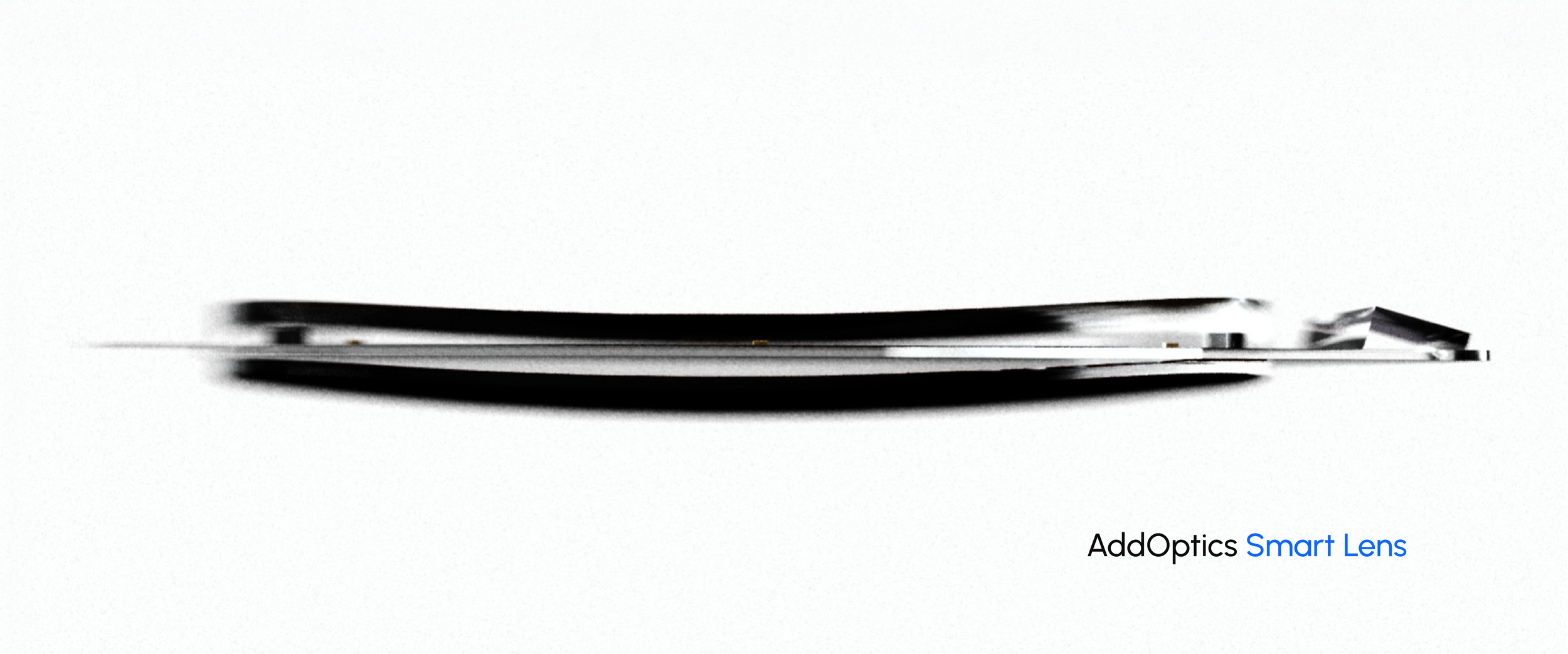
We reduce thickness at the manufacturing level, not through optical compromises. More functionality, without more bulk.
From prototype to mass production
What works in early builds is designed to work in production. The same lens architecture scales without structural redesign.
Integration without stress
Our low-temperature, low-pressure casting process protects delicate components embedded in the lens, ensuring stable alignment and fewer hidden risks.
Scalable by design
Our 80/20 model combines standard mass-production prescription equipment with proprietary integration steps, creating a clear and credible path to scale.
See what thinner means.

What People Ask Us
We have answers to most questions. So if your question isn’t here, get in touch.
-
We make prescription-correctable lenses for smart eyewear. Functional components such as dimming films, eye-tracking elements and other optical layers can be embedded directly into the lens during our proprietary thermal casting process.
The waveguide sits between two lenses, creating a thin, integrated optical system suitable for smart glasses.
-
We use low-pressure thermal resin casting with soft molds. This combines the optical quality of traditional ophthalmic lens manufacturing with the freedom to embed delicate components that wouldn’t survive the temperatures or pressures of injection molding.
-
Electrochromic dimming films, focus-tunable layers, eye-tracking components and other optical or electronic elements.
If your component can survive a controlled thermal curing process, there’s a good chance it can be integrated. We usually run a quick feasibility check to find out.
-
Front lens layers down to approximately 400 microns in production. Thin enough to look and feel like everyday glasses.
In our lab we’ve demonstrated structures down to ~100 microns over embedded elements, showing how thin future smart lenses can become.
-
Yes. We support single-vision prescriptions up to −8 diopters, with freeform surface capability.
This is a key differentiator. Most smart eyewear concepts rely on inserts or clip-ons. We integrate prescription directly into the optical system.
-
It usually starts with an NDA and a short engineering phase where we test how your component integrates into the lens and optimize the manufacturing process.
From first samples to validated prototypes, it typically takes weeks, not months.
-
Yes.
Hard coat, anti-reflective coatings and anti-scratch layers work the same way as in standard prescription eyewear. The lens comes out of the mold in its final shape, ready for finishing.
-
Our casting process produces lenses directly in their final shape. This results in roughly 90% less material waste compared to traditional lens production, which typically starts from larger blanks that must be cut and edged.
Let’s make something remarkable.
Every great lens starts somewhere — a question, a conversation or simply an introduction.